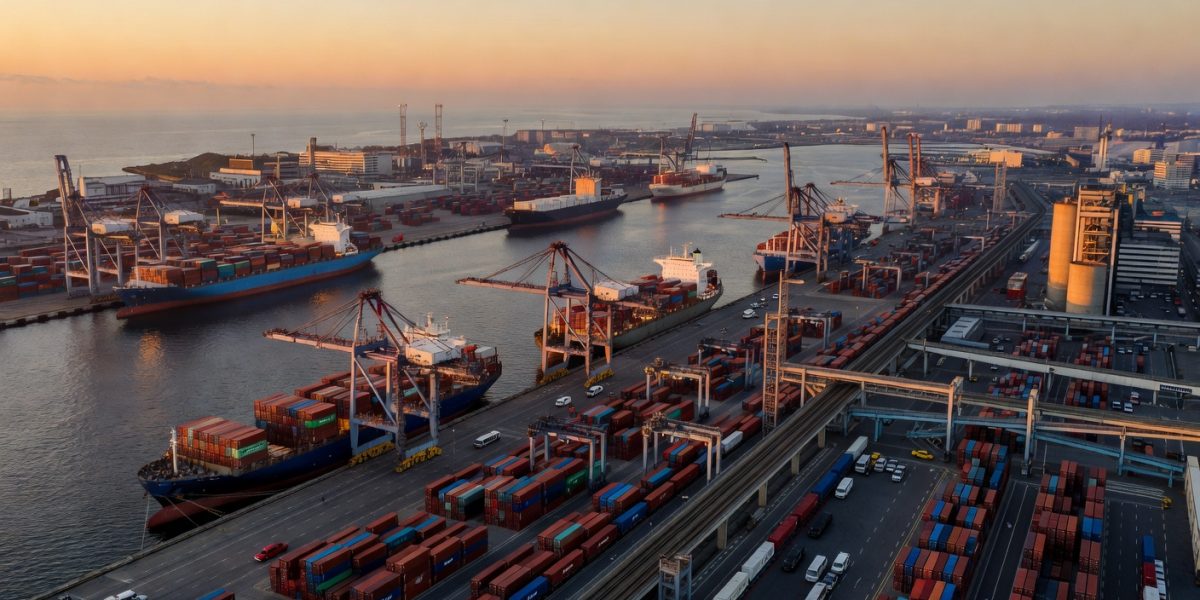
The temporary closure of the Strait of Hormuz — through which approximately 20% of global oil and 25% of liquefied natural gas transits daily — is no longer a tail risk scenario. As of March 2026, IRGC-directed attacks on commercial and GCC-linked vessels, triggered by US-Israel strikes on Iranian assets, have materially disrupted shipping lanes with disruption expected to persist two to four weeks according to S&P Global’s Geopolitical Risk Brief. For European CFOs, General Counsel, and M&A Directors still calibrating post-pandemic supply chain strategies, the signal is unambiguous: geopolitical risk for business has moved from boardroom agenda item to operational emergency.
Energy and Commodity Volatility: The Immediate Exposure
The Hormuz disruption arrives at a moment of otherwise strong macroeconomic momentum — PMI data across major economies remained expansionary entering Q1 2026. That divergence between real-economy strength and geopolitical shock is precisely what makes the current environment treacherous for financial planning.
European firms with energy-intensive operations — manufacturing, logistics, chemicals, and data centre infrastructure — face compounding input cost pressures. Brent crude and TTF gas benchmarks are acutely sensitive to Hormuz transit volumes, and any sustained blockade will accelerate inflationary pass-through into industrial supply chains already strained by the energy transition capex cycle.
Key exposure points for European business leaders include:
- Commodity procurement contracts lacking force majeure or price-indexation clauses adequate for a 2–4 week disruption window
- Insurance and political risk coverage — HDI Global and Marsh/Zurich surveys confirm geopolitical risk now ranks as the number one concern among risk managers globally, yet policy terms have not uniformly kept pace
- Working capital stress from freight cost spikes and inventory build requirements, particularly acute for mid-market firms with thinner liquidity buffers
Structural Trends Amplifying the Shock: Multipolarity, AI, and Critical Infrastructure
The Hormuz crisis does not exist in isolation. It is the acute manifestation of structural forces that EY, BCG, and the World Economic Forum have each identified as defining the 2026 business environment: persistent US-China strategic competition, the fragmentation of global trade into regional blocs, and the weaponisation of economic policy through tariffs, export controls, and critical mineral access restrictions.
Wellington’s analysis of rising defence budgets and national security prioritisation of AI and critical minerals adds a further dimension. Governments across Europe, the Gulf, and Asia-Pacific are redirecting fiscal capacity toward economic sovereignty — a trend that simultaneously creates infrastructure investment opportunities and imposes new compliance obligations on multinationals operating across jurisdictions.
For boards overseeing digital transformation programmes, the intersection of geopolitics and technology is particularly consequential. The WEF’s 2026 risk report flags critical infrastructure vulnerabilities — including cloud dependencies, subsea cable exposure, and semiconductor supply concentration — as systemic risks that no single firm can fully internalise. The 57% of global leaders expecting sustained turbulence are not being pessimistic; they are being accurate.
Implications for Business: Resilience as a Strategic Imperative
The convergence of Hormuz disruption, multipolar trade fragmentation, and national security-driven industrial policy demands a recalibration of corporate strategy — not a reactive one, but a structured, scenario-based approach.
Decision-makers should prioritise the following:
- Supply chain de-risking and onshoring reviews: Map Tier 1 and Tier 2 supplier exposure to Hormuz-dependent energy inputs and Gulf logistics corridors. Dual-sourcing and regional partnership agreements — particularly within the EU’s Strategic Autonomy framework — should be accelerated, not deferred.
- M&A and investment due diligence: Geopolitical risk scoring must be embedded into transaction frameworks. Assets in energy, infrastructure, and critical minerals sectors require jurisdiction-specific analysis aligned with EU Foreign Subsidies Regulation and FDI screening mechanisms.
- Sustainability and energy transition alignment: Paradoxically, the Hormuz disruption strengthens the long-term investment case for renewable energy and domestic energy infrastructure. European firms that have advanced their energy transition programmes hold a structural hedge against fossil fuel price volatility.
- Scenario planning and board-level governance: Geopolitical risk committees — not merely risk registers — should be standard practice. The US-China trade summit expected ahead of April 2026 represents a potential inflection point that boards must be prepared to interpret and act upon rapidly.
Key Takeaway
The Strait of Hormuz disruption is a stress test that exposes the gap between firms that have genuinely built geopolitical resilience into their operating models and those that have treated it as a compliance exercise. With 57% of global leaders anticipating prolonged turbulence, and with supply chain de-risking, AI-driven national security competition, and infrastructure investment all converging simultaneously, the strategic window for half-measures has closed. European business leaders who act with analytical rigour and structural conviction now will define the competitive landscape of the next cycle.
