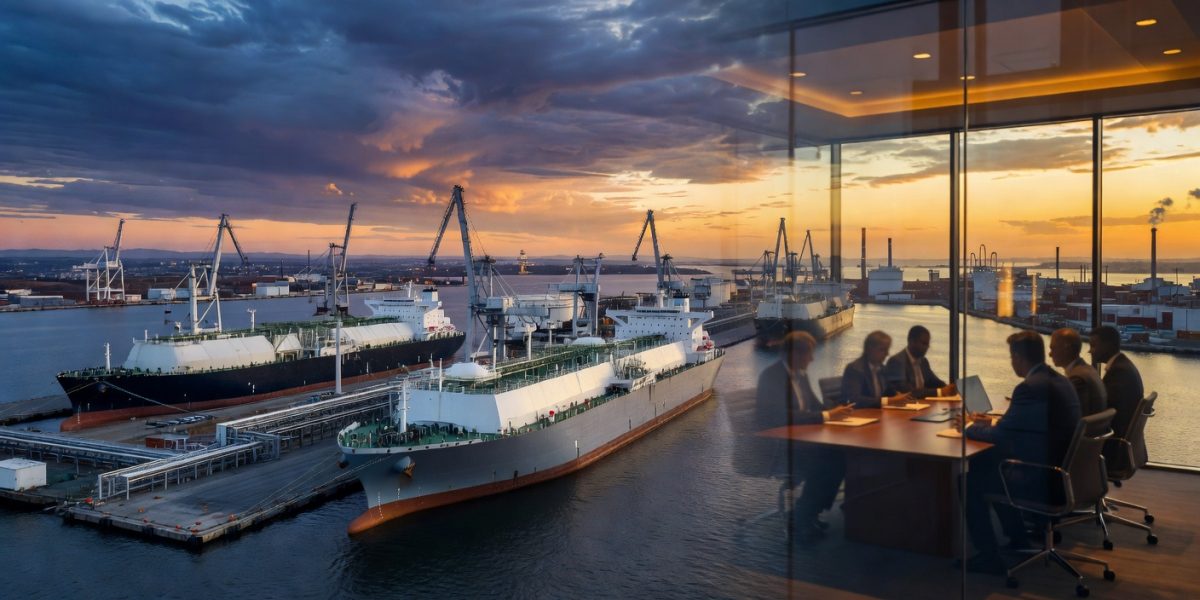
On February 28, U.S. and Israeli forces launched Operation Epic Fury, targeting Iran’s leadership, nuclear infrastructure, and military command. The killing of Iran’s Supreme Leader triggered immediate retaliatory strikes against regional energy infrastructure and renewed threats to close the Strait of Hormuz — a chokepoint through which approximately 20% of the world’s oil and 25% of global LNG supplies transit daily. For European boards and executive teams, this is no longer a tail risk. It is a live operational challenge.
Energy Market Disruption: Europe’s Structural Exposure
Europe’s vulnerability to Middle East energy disruption is structural, not cyclical. Having spent the past three years diversifying away from Russian pipeline gas following the 2022 invasion of Ukraine, European importers pivoted heavily toward LNG — much of it transiting routes sensitive to Persian Gulf stability. A sustained Hormuz closure or prolonged conflict affecting Gulf Cooperation Council (GCC) export terminals would compress LNG availability precisely as the continent manages its energy transition commitments under the EU’s REPowerEU framework.
BlackRock’s Investment Institute has classified the Middle East regional war as the top high-likelihood geopolitical risk in its current dashboard, citing Hezbollah’s continued involvement and Israeli operations in Lebanon as compounding vectors. For CFOs modelling energy cost scenarios, the baseline assumption of gradual price normalisation must now be stress-tested against a prolonged conflict scenario. Industrial energy consumers — chemicals, steel, logistics — face the sharpest near-term margin pressure.
The implications for infrastructure investment and the energy transition are equally significant. Project finance structures for renewables and LNG import terminals in Southern and Central Europe will need to account for elevated sovereign risk premiums, insurance cost escalation, and potential delays in equipment supply chains linked to Asian manufacturing hubs.
Supply Chain Fragmentation and Regulatory Divergence
The Iran conflict does not exist in isolation. It accelerates a broader pattern of geopolitical fragmentation that Insight Forward’s Top 10 Geopolitical Risks for Businesses in 2026 identifies as the defining strategic challenge for mid-market exporters: U.S. transactionalism eroding alliance predictability, escalating tariff regimes, and chip export controls creating asymmetric compliance burdens.
McKinsey’s latest analysis of multinational exposure finds that 95% of European firms operate across divergent geopolitical contexts, with tangible financial consequences already visible. Jaguar Land Rover’s EBIT margin deterioration under U.S. tariff pressure and Intel’s loss of its Huawei export licence are instructive precedents — not outliers. General Counsel and compliance teams must now treat export control mapping as a board-level discipline, not a back-office function.
For M&A Directors evaluating cross-border transactions, geopolitical risk screening must be embedded in due diligence frameworks. Target companies with significant revenue exposure to Gulf markets, Iranian supply chains, or dual-use technology components require enhanced scrutiny under both U.S. OFAC regulations and EU restrictive measures, which are likely to be updated as the conflict evolves.
Strategic Opportunities Amid Volatility
Geopolitical disruption, while damaging in aggregate, creates asymmetric opportunities for agile firms. McKinsey notes that rapid geopolitical realignment is enabling multinationals to capture growth through industrial policy subsidies and new trade corridors in India, Vietnam, and select Southeast Asian markets. European manufacturers with flexible supply chain architectures — capable of shifting sourcing and production footprints within 12–18 months — are better positioned to exploit these corridors than those locked into single-region dependencies.
In real estate and infrastructure investment, energy security is reshaping asset valuations. Logistics hubs, LNG regasification terminals, and data centre campuses with on-site renewable generation are attracting premium pricing as investors reprice proximity to stable energy supply. CTOs and infrastructure investors should treat energy self-sufficiency as a hard specification, not an ESG aspiration.
Implications for Business Leaders
- Energy cost modelling: Rerun P&L stress tests assuming Brent crude at $110–$130/barrel for a sustained 6–12 month scenario and LNG spot premiums of 40–60% above current forward curves.
- Supply chain audit: Map Tier 2 and Tier 3 supplier exposure to Gulf transit routes and Iranian-linked entities before regulatory updates force reactive compliance.
- M&A due diligence: Integrate geopolitical risk scoring — covering export controls, sanctions exposure, and energy dependency — as a standard deal gate.
- Board reporting: Elevate geopolitical risk from risk register footnote to standing agenda item, with quarterly scenario updates from external advisory input.
- Capital allocation: Prioritise infrastructure investment in energy resilience — on-site generation, storage, and supply diversification — as a strategic hedge, not a cost centre.
Key Takeaway
The escalation in the Middle East has moved geopolitical risk from the periphery to the centre of corporate strategy. For European decision-makers, the convergence of energy infrastructure threats, regulatory divergence, and supply chain fragmentation demands a structural response — not crisis management. Firms that build geopolitical resilience into their operating models now will be positioned to absorb volatility and capture the asymmetric opportunities that disruption invariably creates.
