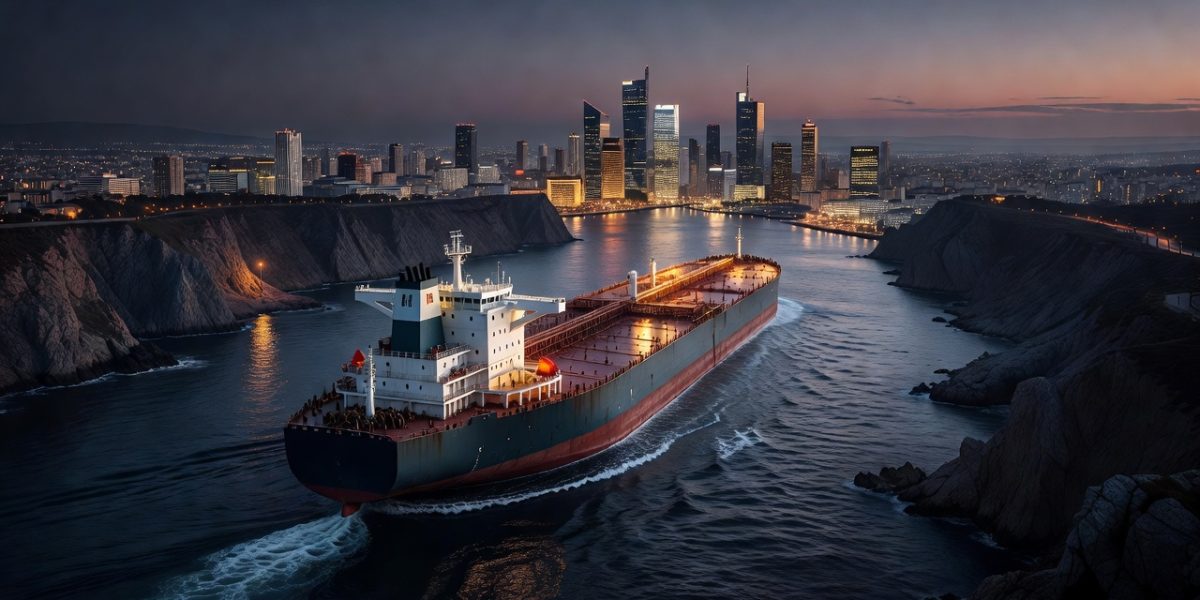
The closure of the Strait of Hormuz — through which approximately 20% of the world’s traded oil passes daily — marks a structural inflection point for global business risk. Combined with the IMF’s revised 2025 GDP growth forecast of 2.4% and the US government’s endorsement of a new tariff regime placing 55% total duties on Chinese imports, European mid-market companies are navigating a risk environment with few modern precedents. For CFOs, General Counsel, and board members, the question is no longer whether geopolitical risk affects operations — it is whether existing frameworks are adequate to manage it.
Energy Security Displaces Transition as the Immediate Strategic Priority
The Iran conflict has triggered the most severe global oil supply disruption since the 1973 OPEC embargo. Energy prices have surged across spot and futures markets, with Brent crude benchmarks reflecting sustained supply uncertainty. For European businesses — already absorbing the residual cost pressures of the 2022 energy crisis — this represents a compounding shock.
The immediate consequence is a forced recalibration of energy transition strategies. Many mid-market industrial and real estate companies had structured multi-year capital allocation plans around declining energy costs and predictable carbon pricing under the EU Emissions Trading System (EU ETS). Both assumptions are now under pressure. Infrastructure investment budgets are being revised upward due to soaring material and energy input costs, while project timelines are extending across the board.
Critically, this does not signal the end of sustainability commitments — it signals a sequencing shift. Energy security and supply chain resilience are becoming preconditions for transition investment, not alternatives to it. Companies that treat these as competing priorities risk misallocating capital in both directions.
Supply Chain Fragility: Tariffs Amplify an Already Stressed System
The US-China trade escalation adds a second, distinct layer of structural disruption. With total tariffs on Chinese goods reaching 55% and technology export tariffs threatened at up to 155%, European manufacturers and technology-dependent businesses face a bifurcating global supply architecture. The practical consequences are already visible: longer lead times, higher component costs, and growing pressure to qualify alternative suppliers in Southeast Asia, India, or domestically within the EU.
For companies operating under the EU Corporate Sustainability Reporting Directive (CSRD) or preparing for supply chain due diligence obligations under the Corporate Sustainability Due Diligence Directive (CS3D), this fragmentation creates a compliance dimension alongside the commercial one. Rapid supplier substitution without adequate due diligence introduces ESG, legal, and reputational exposure that boards must account for explicitly.
The OECD’s revised growth forecast of 2.5% for 2026 — down from earlier projections — reflects the compounding drag of energy shocks and trade friction. For deal-makers assessing M&A targets, revised macro assumptions must now be embedded in base-case financial models, not treated as downside scenarios.
Implications for Real Estate, Infrastructure, and Investment Confidence
The real estate and infrastructure sectors face a particularly acute set of pressures. Construction cost inflation, driven by elevated energy and fertilizer prices (the latter directly linked to gas feedstock costs), is compressing development margins and forcing project deferrals across Europe. Institutional investors are recalibrating return expectations on long-duration infrastructure assets as discount rates and input cost assumptions shift simultaneously.
For real estate portfolios with significant energy infrastructure exposure — logistics, data centres, industrial — the risk is asymmetric. Assets with embedded energy resilience (on-site generation, long-term power purchase agreements, high energy efficiency ratings) are increasingly commanding valuation premiums. Those without are facing accelerated obsolescence risk.
Key actions for decision-makers to consider now:
- Stress-test energy cost assumptions in all active financial models using a sustained $120–140/barrel Brent scenario.
- Audit supply chain single-points of failure linked to Hormuz-dependent shipping routes or Chinese technology components.
- Review M&A due diligence frameworks to incorporate geopolitical risk scoring alongside traditional financial and legal analysis.
- Engage boards on scenario planning that treats geopolitical disruption as a recurring operating condition, not a tail risk.
- Reassess sustainability roadmaps to prioritise energy security investments that are also transition-compatible — renewable on-site generation, efficiency retrofits, demand flexibility.
Key Takeaway
The convergence of the Hormuz crisis, revised IMF and OECD growth forecasts, and US-China tariff escalation represents a systemic geopolitical risk event, not a cyclical correction. European business leaders who treat this as a temporary disruption to be managed through short-term hedging will find themselves strategically exposed. The firms that will emerge with competitive advantage are those that use this moment to build durable resilience — in energy supply, supply chain architecture, and investment strategy — while maintaining the discipline to distinguish between what must change now and what remains sound for the long term.
